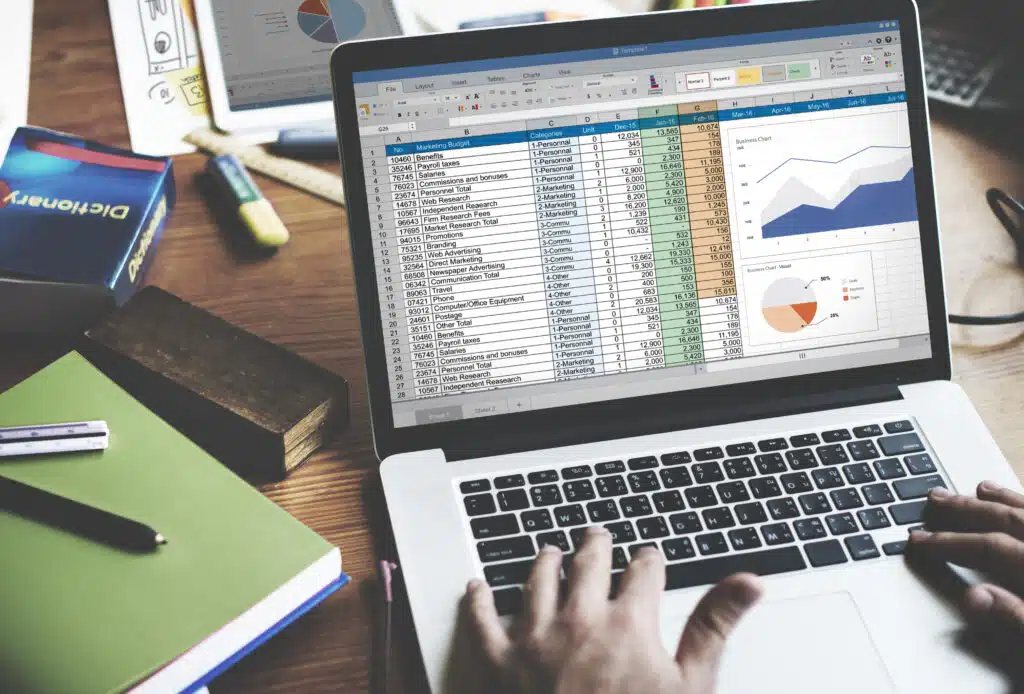

7 reasons why Excel has had its day as an IT tool – and which spreadsheet alternatives there are
For a long time Excel was the standard tool for many companies when it came to data management, reporting and calculations. But in a modern business world that needs efficient and scalable solutions, Excel has had its day as an administration tool. Here are seven reasons why it is time to replace Excel with modern software and switch to an up-to-date alternative.
1. Excel does not scale
Many companies use Excel far beyond its original functions, but it quickly reaches its limits. As soon as larger amounts of data are involved, the file becomes slower and the likelihood of a crash increases. For growing companies this is a major risk. Cloud-based solutions instead of Excel, such as specialised ERP systems, are scalable and make it possible to process even large amounts of data securely and quickly.
2. High error rate with manual input
A big problem with using Excel is the high susceptibility to errors from manual input. Even a small mistake in one cell can have expensive consequences. Automated Excel alternatives for companies offer built-in validation functions that detect incorrect entries early and drastically reduce the error rate.
3. Difficult teamwork
When several employees work on an Excel file at the same time, version conflicts quickly arise. It is often unclear which version is the latest, which leads to misunderstandings. Craftcloud’s cloud-based IT solutions, on the other hand, enable smooth, mobile data management without Excel, with interactive real-time updates of records. Every employee always works on the current version, and changes are synchronised immediately.
4. Excel offers only limited automation
While Excel offers some automation features such as macros, these are often complicated and require programming skills. Modern tools, by contrast, offer user-friendly automation options that can be used without in-depth technical know-how. Such Excel alternatives save valuable time by automating repetitive tasks.
5. Poor data security
Excel files are particularly vulnerable to manipulation and hacker attacks. Even with password protection, data security is not guaranteed. GDPR-compliant inventory software such as Craftcloud’s offers advanced security features such as encryption and role-based access rights to protect sensitive data from unauthorised access.
6. Limited data analysis
Excel is useful for simple calculations, but when it comes to deeper data analysis it quickly reaches its limits. Companies that depend on sound analyses should use a specialised inventory management system or CRM. Craftcloud’s project-oriented CRM, for example, offers powerful analysis functions and interactive dashboards that are difficult to implement in Excel.
7. Lack of integration with other tools
Excel offers only limited options for integration with other business systems. In medium-sized companies, however, smooth integration with ERP or inventory management is essential. Administration tools without Excel have APIs for existing systems and thus simplify decentralised data management.
Conclusion: Excel may have been a useful digital tool in the past, but for companies that want to work efficiently and without errors there are better alternatives today. Cloud-based solutions and specialised software for data management without spreadsheets, project management tools and advanced data analysis without Excel tables offer more flexibility, security and scalability.
If your company is looking for an alternative to Excel, it is worth switching to more efficient administration tools such as Craftcloud.